24th International Workshop on Verification of Infinite-State Systems

  • INFINITY 2026 was a 1-day satellite workshop of ICALP 2026
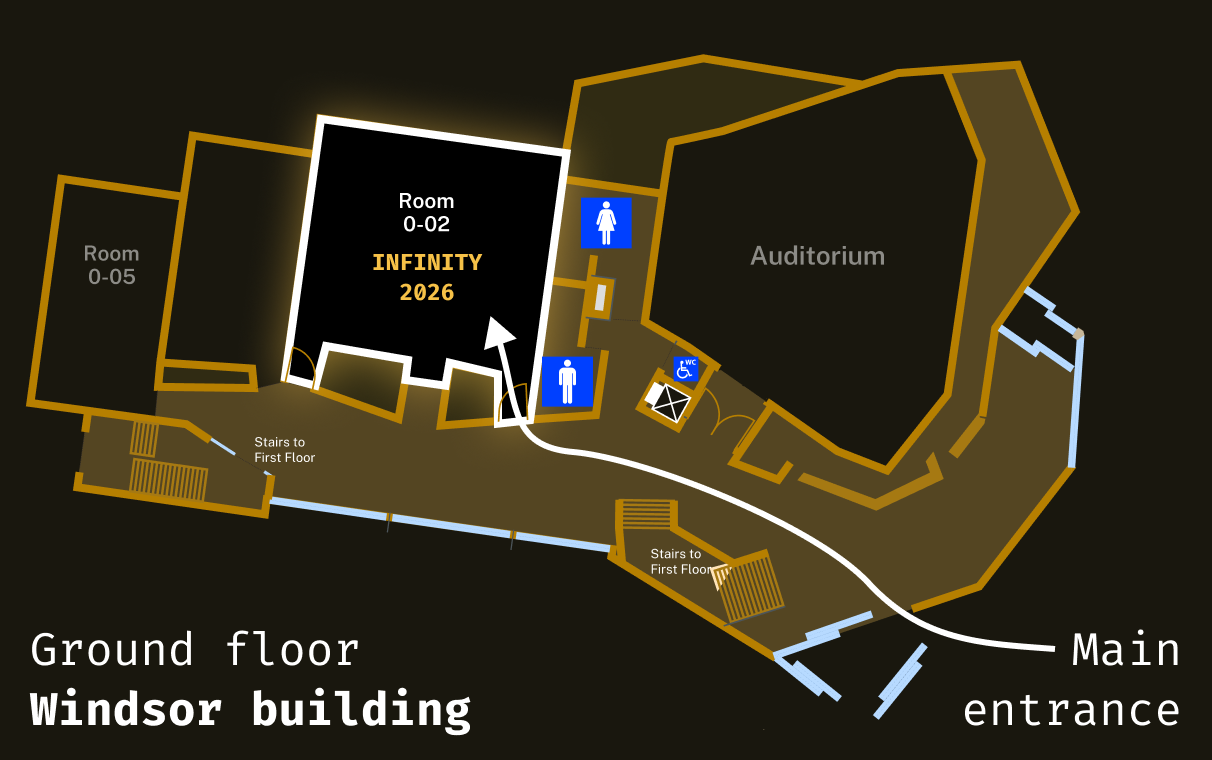
  • Royal Holloway, University of London (Egham, UK)
  • Monday, July 6, 2026

The aim of the INFINITY workshop is to provide a forum for researchers interested in the development of mathematical techniques for the analysis and verification of systems with infinitely many states. The focus of the 2026 edition of INFINITY was on fine-grained questions in automata theory and verification.

Typical examples of infinite-state systems include models such as Vector Addition Systems (VAS), Petri nets, and automata with data structures, which correspond to key classes of systems studied in the ICALP Track B community. At the same time, in the ICALP Track A community a theory of fine-grained complexity has developed, aiming to obtain precise lower bounds on the running time, usually conditional on well-established hypotheses.

The goal of INFINITY 2026 was to bring together researchers from both communities to exchange recent developments, identify common challenges, and foster new collaborations.

Invited speakers

Programme

09:05–09:10
Welcome
09:10–09:55
Fine-Grained Complexity and Formal Languages
Henning Fernau
Abstract
In this talk, some basic ideas of fine-grained complexity are introduced. This includes the presentation of key hypotheses like (S)ETH, OVH, APSP and 3SUM. In the second part of the talk, we will explain how to base conclusions on these hypotheses for problems arising in formal languages, in particular, in automata theory and parsing.
09:55–10:00
Introductions
10:00–10:30
Coffee
10:30–11:15
Precise Complexity Analysis of Coverability in Vector Addition Systems
Henry Sinclair-Banks
Abstract
Coverability in Vector Addition Systems with States (VASS) is a well-known, well-studied, fundamental problem for infinite-state systems. In short, VASS can be seen as finite automata equipped with non-negative integer counters that can be incremented and decremented but cannot be zero-tested. Over the last few years, our understanding of the exact complexity of coverability in VASS has significantly improved. In this presentation, I will explain: (i) a conditionally optimal ETH-based lower bound on the time required to decide coverability in VASS with a non-fixed number of counters, (ii) a conditional lower bound on the time required to decide coverability in unary-encoded VASS with two counters, and (iii) the state-of-the-art complexity of coverability in binary-encoded VASS with one counter.
11:15–11:25
Mini break (no coffee)
11:25–12:15
Spotlight talks
  • Fine-Grained Complexity of Ambiguity Problems on Automata
    Anita Dürr
    Abstract
    In the field of computational logic, two classes of finite automata are considered fundamental: deterministic and nondeterministic automata (DFAs and NFAs). In a more fine-grained approach three natural intermediate classes were introduced, defined by restricting the number of accepting runs of the input NFA. The classes are called: unambiguous, finitely ambiguous, and polynomially ambiguous finite automata. It was observed that central problems, like equivalence, become tractable when the input NFA is restricted to some of these classes. This naturally brought interest into problems determining whether an input NFA belongs to the intermediate classes. I will present a nearly complete characterization of the fine-grained complexity of these problems: the respective quadratic and cubic running times of Allauzen et al. are optimal under the Orthogonal Vectors hypothesis or the \(k\)-Cycle hypothesis, for alphabets with at least two symbols. This is based on the work available at https://arxiv.org/abs/2501.14725.
  • A quick guide to the APSP conjecture
    Jakob Nogler
    Abstract
    The aim of this talk is to spark your interest in one of the three central hypotheses in fine-grained complexity: the All-Pairs Shortest Path (APSP) conjecture. The conjecture asserts that no algorithm can compute pairwise distances in a graph faster than \(O(n^{3-a})\) time for any \(a > 0\). I will demonstrate how this assumption can be used not only to prove the conditional optimality of your own algorithms, but also be used to speed them up. We will briefly cover why you should definitely know about the conjecture (even if you are not from the field), and where to find more. Along the way, I will also mention open problems and recent results, both my own and from others.
  • Classifying Identities: Subcubic Distributivity Checking and Hardness from Arithmetic Progression Detection
    Mirza Redzic
    Abstract
    We study the complexity of verifying algebraic identities on finite structures. While previous work gave an optimal randomized algorithm for testing associativity, whether distributivity could be verified in subcubic time remained open. We resolve this by giving an \(O(|S|^\omega)\)-time algorithm for distributivity, together with a matching conditional lower bound based on the Triangle Detection Hypothesis. We propose arithmetic progression detection in small universes as a consequential algorithmic challenge: we show that unless we can detect 4-term arithmetic progressions in a set \(X \subseteq \{1,\dots,N\}\) in time \(O(N^{2-\varepsilon})\), then (a) the 3-uniform 4-hyperclique hypothesis is true, and (b) verifying certain identities requires running time \(|S|^{3-o(1)}\). Finally, we classify a large family of 3-variable identities into three complexity classes: quadratic, \(O(|S|^\omega)\), or cubic (all with matching conditional lower bounds), and obtain near-optimal algorithms for verifying whether a finite algebraic structure is a field or a ring.
  • Intersecting Dense Automata: Constructions, Complexity and Certificates
    Neha Rino
    Abstract
    Given \(k\) nondeterministic finite automata (NFA), constructing an NFA that recognises the intersection of their languages is a basic problem in automata theory. We observe that the classical Cartesian product construction is non-optimal in the worst case, namely when the automata have many transitions. For a fixed alphabet, the Cartesian product of two NFA may have \(\Theta(m^2)\) transitions if these NFA have at most \(n\) states and \(m\) transitions each.
    In this talk, we give alternative constructions with \(O(m n)\) transitions, and more generally with \(O(m n^{k-1})\) transitions for the intersection of \(k\) NFA (for fixed \(k \ge 2\) and alphabet \(\Sigma\)). This yields a faster algorithm for the NFA intersection emptiness problem (NFA IE), which we prove optimal unless there is a breakthrough in combinatorial algorithms for detecting \((k+1)\)-cliques in undirected graphs (i.e., under the Combinatorial \(k\)-Clique Hypothesis). Finally, we show that these constructions also provide a faster certification scheme for NFA IE, suggesting that a tight fine-grained reduction from Boolean satisfiability (SAT) to NFA IE is unlikely. This is joint work with Dmitry Chistikov.
12:15–12:30
Free time
12:30–14:00
Lunch
14:05–14:50
Fine-Grained Dichotomies for evaluating database queries
Nofar Carmeli
Abstract
Consider the task of evaluating queries over databases. We will start by considering a very simple class of queries: join queries, and a simple question: when can the query answers be enumerated with ideal time guarantees (linear preprocessing and constant delay)? As time permits, we will progress into more expressive query classes (conjunctive queries and unions of conjunctive queries), and into more demanding query-answering tasks, such as allowing direct access to query answers (i.e., simulating a sorted array containing the answers), every time asking a similar question. The answer to such a question is always a dichotomy: a condition on the query structure, an efficient query evaluation algorithm in case it is satisfied, and a conditional lower bound in case it is not.
14:50–15:20
Coffee
15:20–16:05
On The Fine Grained Complexity of Multi-Stack Reachability
Michael Wehar
Abstract
Determining whether there exists a string that is accepted by a given pushdown automaton (PDA) is referred to as the non-emptiness problem for pushdown automata. This is a classic problem that is complete for polynomial time. Attempts to prove an unconditional superlinear time complexity lower bound for this problem have been unsuccessful. However, an unconditional time complexity lower bound can be proven for the intersection non-emptiness problem for one PDA and multiple DFAs. We apply this result to show a lower bound for the non-emptiness problem for multi-stack pushdown automata with bounded phase switches (i.e. multi-stack PDAs where all stacks can push, but only one designated stack can pop per switch). In particular, for \(k\) phase switches, we prove a near-tight time complexity lower bound of \(n^{\Theta(2^k)}\) where \(n\) is the number of states and \(k\) is the number of phase switches.
16:05–16:15
Mini break (no coffee)
16:15–17:00
On the Fine-Grained Complexity of Concurrency Testing
Andreas Pavlogiannis
Abstract
Concurrency is ubiquitous and comes in various forms, from multi-threading inside a CPU to distributed systems, databases, and the internet of things. Testing whether a concurrent system adheres to its prescribed behavior is a natural algorithmic task, and a de-facto practice among researchers and system developers. In this talk, we will overview the algorithmic complexity of testing various systems and properties, through the fine-grained lens. This is a rich landscape, even more so since concurrent systems exhibit natural syntactic parameters, such as the number of communicating processes, the number of shared objects, etc. We will also study concurrency testing from the perspective of modern weak memory, whereby a concurrent system is allowed to exhibit complex and often counter-intuitive behaviors that escape the standard interleaving view. The plethora of weak memory models provides a fertile ground for fun and interesting fine-grained complexity questions of practical relevance, some of which we will tackle in this talk.
17:00–17:10
Mini break (no coffee)
17:10–17:55
Online Orthogonal Vectors Revisited
Alexander Golovnev
Abstract
We prove new upper and lower bounds for the Online Orthogonal Vectors Problem (OnlineOV). In this problem, a preprocessing algorithm receives \(n\) vectors and constructs a data structure of size \(S\). Subsequently, a query algorithm receives a vector \(q\) and, in time \(T\), determines whether \(q\) is orthogonal to any of the input vectors. Using a novel structure-versus-randomness decomposition, we design data structures that outperform all known constructions and refute a conjecture regarding the hardness of OnlineOV. On the lower-bound side, assuming the Non-uniform Strong Exponential Time Hypothesis, we prove arbitrarily large polynomial lower bounds on the space \(S\) required by any OnlineOV data structure with computationally unbounded preprocessing and sublinear query time.
18:00–19:00
Reception
19:00–21:30

Informal workshop dinner

After the official ICALP reception on Monday, 6 July, participants joined an informal dinner at 19:00, split into two groups, one per venue.

Liberto Lounge

Centre of Egham — about 20 min walk from the university accommodation. Google Maps

Large selection of cuisines, with plenty of vegetarian options.

The Beehive

34 Middle Hill, Englefield Green, Egham TW20 0JQ — 13 min walk from the reception venue. Google Maps · OpenStreetMap

Classic British gastropub with hearty mains.

This was not an official part of the workshop, and each participant covered their own meal.

Register

Registration is now closed. Registration is required for attendance and is handled via the main ICALP registration system.

Local info

The workshop took place in person at Royal Holloway, University of London, UK, as a satellite workshop of ICALP 2026. Royal Holloway is located in Egham, Surrey, which is approximately 20 miles (40 minutes by rail) from central London.

The campus is a 15-20 minute walk from Egham station, which has regular train services from London Waterloo and Reading. For guidance on travel and accommodation, as well as local information and suggested hotels, we recommend checking the main ICALP website.

Acknowledgements

We are grateful to the Engineering and Physical Sciences Research Council (EPSRC, UK) for support. [EP/X03027X/1]

Organisation

INFINITY 2026 was organised by: